Friday, January 30, 2009

“Modernists are pushing Russia into infernal darkness”


Alexey Beliayev-Guintovt, the 2008 winner of Russia’s Kandinsky Prize, on the struggle for the future of Russian art.

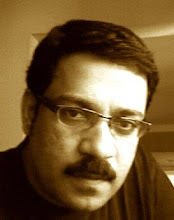
On 8 December, Beliayev-Guintovt was known only to the small community of people who closely follow the Russian contemporary art scene. But overnight he became one of the most talked-about Russian artists in the past two decades. “Before the prize, my website had only a few hundred hits a day,” he says. “Now it has several thousand a day.”

The Art Newspaper is the first publication invited to visit his modest three-room apartment/art studio, in a working-class neighbourhood in his native city, Moscow. The walls of one room are decorated with a 19th-century print featuring Napoleon at Waterloo in 1814, and a Soviet banner emblazoned with the words “Workers of the World Unite”. There is a bust of Lenin on the shelf. The furniture is late 19th century, except for an ornate chair that Beliayev-Guintovt says is probably 18th-century Persian. “I call it my Eurasian throne,” he says.

The television is playing a 1937 Soviet propaganda film showing Stalin inspecting a parade of robust athletes on Red Square. “This was basically a parade of Eurasian athletes; just look at the faces,” he says. The screen shows the youthful features of Slavs, Central Asians and people from the Caucasus region. “My next project will be based on this parade,” he adds. “I want to do a Eurasian parade of the future, depicted in about 15 large paintings. I want to give a futuristic view to the Soviet-Stalinist aesthetic.”

Beliayev-Guintovt doesn't hide his fondness for the Stalinist-era aesthetic, and he is uncomfortable when it comes to passing judgment on the Soviet dictator. “I had family members on both sides during the Stalin era. Some worked for the NKVD (secret police), while others ended up in the Gulag.”

“My style unites space and time, and Eurasian ideals are very prominent,” he says. “Art in Russia has always had a very strong social component. I am at the epicentre of a conservative revolutionary movement that includes many nationalities, from Islamic mystics to Russian Orthodox old believers.”

Beliayev-Guintovt says that contemporary art in Russia, as it ascribes to current international art trends, is run by a “totalitarian sect” and that “modernists are pushing Russia into infernal darkness”.

“The controversy over my art is a classic battle between icon painters and iconoclasts,” he says. “They want to destroy the sacredness of images, and I want to exalt it. This is a very serious struggle over the future of Russian art, and with me getting the Kandinsky Prize, they’ve lost a major battle.”

During Perestroika in the late 1980s, Beliayev-Guintovt, born in 1965, dabbled in a variety of western youth counter-cultures. “I was a hippie, a punk, a new waver,” he says. He began his artistic career in 1985, but his big break came in 1994 when gallerist and artist Alexander Yakut took him under his wing.

His painting technique involves covering the canvas with gold leaf and creating an image with a stencil. He then dabs his palms in paint and presses them onto the canvas, his hands working as his brush. “I don't sign my work because my handprint can’t be faked,” he says. “My images might look traditional, but the texture and technique is certainly contemporary. My method combines the traditions of icon painting with the technology of Soviet avant-garde poster-making.”

Today, promoting his Eurasian ideas is Beliayev-Guintovt’s paramount concern. In essence, these ideas call for Russia to turn away from the west and towards the east, and strive for a rebirth of the Russian empire in its tsarist-era borders. Regarding art, he supports “the righteousness of classicism” and “the power of beauty”. Yet he admits his art manifestos are also intended to poke fun at and provoke his detractors on the artistic Left. This of course leaves one wondering whether all his talk about ideology is serious or just an artistic ruse.


John Varoli | 28.1.09 |


Tuesday, October 28, 2008

The Two Faces of Takashi Murakami


He's high art. He's low culture. He's a one-man mass-market machine.

Takashi Murakami is often billed as the next Andy Warhol. Like the American pop art icon, he fuses high and low, pulling imagery from consumer culture to produce visually arresting, highly original work. He is vigorously, ingeniously self-promotional. In the past few years, Murakami has swept across the US and Europe, receiving fawning media attention and exhibiting at big-name museums. Just shy of 42, the charismatic artist even lives and works in what he calls a factory. How much more Warhol can you get?
But there's a key difference. Warhol took from the low and gave to the high. With ironic detachment, his work - paintings few could afford, films few could understand - appealed to an audience in on the joke. Murakami, on the other hand, takes from the low and gives to the high, the low, and everything in between. He makes paintings, sculptures, videos, T-shirts, key chains, mousepads, plush dolls, cell phone caddies, and, last but not least, $5,000 limited-edition Louis Vuitton handbags. Murakami's work hits all price points: This fall he plans on selling plastic figurines packaged with bubble gum - a Murakami for $3. Warhol died before a T-shirt company licensed his soup cans and made a bundle. Murakami, who reads Bill Gates for management tips, knows better than to make that mistake.

It may be old hat to draw ideas and imagery from the mass market, but it's something else to hawk your wares in the candy aisle. In this as in other things, Japan may be leading us into the future. Murakami, who grew up in Tokyo, sees his heritage as key to his art: "The Japanese don't really have a difference or hierarchy between high and low." His "art merchandise" is dominated by a cast of creepily cute characters inspired by manga comics and anime cartoons - the twin pillars of Japanese pop culture. Cartoon characters have figured in high art since Roy Lichtenstein first transferred a Sunday comic to canvas in the early '60s. But the art establishment - steeped in old-world prejudices against mass merchandising - took Lichtenstein and Warhol's art as a critique. Murakami's work celebrates commerce, and commerce returns the favor: His Vuitton handbags have become one of the French fashion house's best-selling lines. Speaking through an interpreter, Murakami explains that his art process is "more about creating goods and selling them than about exhibitions." Not that he's shunning the big shows. In September, a 23-foot sculpture of one of his trademark characters - Mr. Pointy, a cross between a blissed-out Buddha and a space alien - went up in New York City's Rockefeller Center.

Murakami began his art career as a traditionalist. During his twenties at Tokyo National University, he worked on a doctorate in Nihonga, an amalgam of Western and Eastern painting styles dating to the late 19th century. But after witnessing the rise of anime and manga in Japanese culture during the '80s, he grew disillusioned with Nihonga, finding it irrelevant to daily Japanese life. He wanted to create something that would leave a lasting impression. "I set out to investigate the secret of market survivability - the universality of characters such as Mickey Mouse, Sonic the Hedgehog, Doraemon, Miffy, Hello Kitty, and their knock-offs, produced in Hong Kong," Murakami wrote for a 2001 retrospective of his work. The result, in 1993, was Mr. DOB, Murakami's most ubiquitous and enduring character.

Now, as president of Kaikai Kiki, Murakami presides over an art-making corporation that operates from a campus of buildings known as the Hiropon Factory, outside Tokyo, as well as a studio in Brooklyn. While Warhol's Factory featured such colorful characters as Candy Darling, Lou Reed, and Edie Sedgwick, Hiropon is peopled by accountants, publicists, managers, and a computerized administrative system. "Staff members type up reports of what they work on each day. We then send everyone an email that compiles all the reports," explains Yuko Sakata, Kaikai Kiki's New York exhibition coordinator. Murakami, she says, got the idea for daily logs after reading Gates' Speed of Thought.

Murakami owes much of his success to the highly efficient Hiropon Factory. Hardly a reclusive artist toiling in his garret studio, he employs 25 assistants to perform specialized tasks, and he uses technology in pragmatic, labor-saving ways. Because his work features a number of recurring motifs - eyeballs, mushrooms, flowers - the factory maintains an immense electronic archive of renderings that he can cut and paste into the files he's working on. Murakami may be the first artist to make paintings from his own portfolio of digital clip art.

Each creation begins as a sketch in one of numerous pocket-sized notebooks. Full-size drawings are then scanned into the computer. From there, Murakami "paints" his works in Adobe Illustrator, tweaking the composition and cycling through thousands of colors until at last he hands the finished versions off to his assistants. His staff then prints out the work on paper, silk-screens the outline onto canvas, and commences painting. Without this embrace of technology, Murakami says, "I could have never produced this many works this efficiently, and the work wouldn't be as intense."

The fusion of art and computing led Murakami to a pictorial style that rejects the illusion of depth and perspective. Dubbed superflat, the approach isn't entirely new - Warhol's paintings often read flat - but Murakami has something else in mind. Superflat captures the aesthetics of our technological age: PDAs, digital billboards, flat-screen TVs. An exhibition curated by Murakami, titled simply Superflat, made its way to the Los Angeles Museum of Contemporary Art and the Walker Art Center in Minneapolis in 2001. "I'm amazed at how that show continues to reverberate," says Michael Darling, an assistant curator at LA MoCA who helped bring the show to the States. "Superflat also refers to the leveling of distinctions between high and low. Murakami likes to flaunt that he can make a million-dollar sculpture and then take the same subject and crank out a bunch of tchotchkes."

The danger is that Murakami's unapologetic hucksterism may obscure just how good his art is. His images are disturbing and beautiful, and, above all, full of ideas. This alone won't secure his place in art history. What should is the way he marries talent to a keen understanding and manipulation of market forces. And unlike Warhol, when college kids plaster Mr. DOB on their dorm walls, he gets paid.

Jeff Howe (jeffhowe@wiredmag.com) is a contributing editor at Wired.

Saturday, October 25, 2008

Banksy wall 'art' to be painted over


LONDON'S Westminster Council says a work by underground artist Banksy is graffiti and will be painted over.
The 7m tall work, painted in giant white letters on a concrete wall in April, was intended as a criticism of Britain's Big Brother culture and specifically the prevalence of CCTV cameras. "One Nation Under CCTV'', it screams, from a wall on which a CCTV camera is also mounted. A child figure perched in a letter appears to be painting the message on the wall, which overlooks a post office yard in Oxford Circus. The work, Banksy's biggest in London, was painted under the cover of darkness after the artist managed to erect three storeys of scaffolding behind a security fence, despite being watched by the CCTV camera.
But Westminster Council says the work will be painted over, The Times reported today. The council says it will remove any graffiti, regardless of the reputation of its creator. Banksy has no more right to paint graffiti than a child, the council says. "If we condone this then we might as well say that any kid with a spray can is producing art,'' Robert Davis, the chairman of Westminster's planning committee, told The Times. "To go and deface other peoples property is graffiti. Just because he's famous doesn't give him that right.'' Banksy started out as a street artist, but his work is now coveted by celebrities and has earned him a lot of money.

In February, his Andy Warhol-inspired screen print of supermodel Kate Moss sold for £96,000 ($210,550) at a street art auction in London. And a wall he had painted sold for £208,100 ($453,700). Banksy's work has been bought by actress Angelina Jolie and singer Christina Aguilera.

Sunday, October 12, 2008

Quest for Identity


The theme of this project is provoked by the strange history of a community known as the Parsi. This community was displaced from its roots in Iran in the 7th century AD and settled on the hospitable shores of India. The Parsi community traveled down to India to save themselves from religious persecution. It grew from a handful of migrants to approximately 1,11,500 as per the 1941 Indian census. In order to preserve the “purity” of lineage, certain conventions came to be set by orthodox members of the community. For instance, anyone not born a Parsi could not convert to become a Parsi and a Parsi could not marry outside the community. This is perhaps a key reason for the continuous decline of the community to a paltry 69,601 in 2001.

The objective of my project is to capture some of the insecurities that plague this exceptionally small community, one which is attempting to retain its identity in the melting pot of the 21st century. I have reflected this by taking up the issue of marriage within the community, an age-old system that is still followed to retain the purity of the community, thereby not allowing the community to grow. Ironically this is not stated in the Avestain scriptures. My work also questions the rules and the value system of the community which alienates women from outside of the community who marry into the Parsi community thus commenting on dominance of the male character in the community. This project is a personal expression of how I feel about the issue of identity of the Parsi community as well as the women who live within it.

Varun Cursetji- www.artconcerns.com

Sunday, October 5, 2008

Interview with Mr. Cheng from Xin Dong Cheng Gallery


AfN: Dear Mr. Cheng, you just did a book presentation: a Chinese translation of the French book "Art Business" by Judith Benhamou-Huet. Why have you chosen that book to translate into Chinese? And how was the presentation?


Cheng: China is completely new in the art system. We were building the system with old artistic elements, so all this information is very very useful to help China to do its first steps towards the restauration of artists, galleries, artists, museums, auction houses... 

Judith Benhamou is a French journalist, a person who has a lot of experience because she travels a lot in the world, a specialist of the art markets... I found information in her book that can be useful for China. That is why I did it [the translation] - because I think it is good, and because I see a financial chance in everything, and because I think it is very useful for the Chinese public.


AfN: So the wider Chinese audience is still not very familiar with the Western system of how the art world is organised. Why is that?


Cheng: After a special period in the past, when the country went through war, after certain political moments, after the cultural revolution, completely all systems of art collapsed. 

With the new era of globalisation, Chinese will know a lot of new things; I am not sure if that is good, if the Western systems are good for China, but anyway, they can learn something from that. They can compare. There are so many experiences which are useful for China.


AfN: And do you publish these books on your own. Do you have a publishing house?


Cheng: That is why I created a publishing house. I am not really a publisher... We are the new Chinese generation, and we are actually living the new era; life changed so quickly, and China becomes more and more open to the world. Every day there is so much information... I have never experienced that before. I did not learn that at school. So for us, it is new. We are acting, and we are learning something, and then you know how to do it.


AfN: We would like to know a little bit about you. When did you open your first gallery, and what is your background?


Cheng: First, I studied in China. I passed the national examinations. It was very hard. Less than 1% of people could pass the examination and go to university. But it was still much better than during the cultural revolution when all the universities were closed. But the competition was very hard; everything was managed by the government, they chose the best students to study science because at the beginning of the 20th century, they were thinking: "Only science and technology can help China - China has lost so many wars, they need the technology." So I studied science here. I did not want to, but back then, I was 15 years old, and the government chose the students to learn something - no discussion, everything was organised and paid by the government. But the first year after, I said to myself: "This is not what I want to do." Young Chinese people did not have the choice so they learned and finished. And then, with the opening-up in the 80s, we learned a lot of things outside of the school system - from the society, from TV, the publishing books. At that time, I was the leader of a student movement, so I organised a lot of dialogues, art forums, discussions. After Mao Zedong, and the new economic reform, with the new leader, everything was completely different so we learned again - we were learning about the real China, to know it better, the Chinese culture, geography... everything - even Confucianism! It is an old philosophy but we did not learn this in school. So it was a completely different China!... The young people looked at China like at a new country, like a baby. So I wanted to change, too, but there was no chance. The only thing I could do was to learn something from somewhere else.


AfN: And then you went to Paris?


Cheng: Not so quickly. In '83, the central government suddenly changed the politics against the reformists. I had organised a lot of conferences and dialogues, so I was criticised by the school. It was forbidden for me to organise anything. The only thing I could do was to study science. At that time, we could only pass examination after examination; I made a master, doctorate, I came back. I wanted to change, to learn something else but I finished my four years of studies in science, chemistry - I had no choice. I was sent to the countryside to work in a pharmaceutical factory for two years. I wanted to show that I can do better, so I studied again. I passed again examination after examination. I chose another city like Xian which was a bit further of where I come from. I wanted to go back to the origins of China's cultural heritage so I went to Xian to study philosophy. But at that time, chemistry was the only thing that I could do. Then, I was again chosen as the leader of a students movement, and at the beginning of '86, the situation changed again, there was again a change of leadership. 


Studying at that time was very hard; just a few books were translated. What we knew about Europe, were names like Victor Hugo, Emile Zola... nothing about the contemporary world. So when China opened up a little bit, I have seen several images in the publication books, but all in all, there was very little information, no internet, mainly propaganda. What we tried to do is to find all the information possible. From all people in China we were the first generation that went to foreign countries to study. As I passed every examination, I was allowed to go to France to study, at the beginning of '89.


AfN: So you were sent to France?


Cheng: Yes. I passed the examination for it. And at that time, I met a French girl, love story..., so we took the train together: Beijing-Moscow, Moscow-Warsaw... it went slowly...


When I arrived at the Gare du Nord, I immediately fell in love with the city Paris. So I studied there, and, of course, it was very important to learn the language first; everything was new for me. All I knew about Paris were names like Victor Hugo and Emile Zola, several new books written by Jean-Paul Sartre, Simone de Beauvoir and very few books and images of Paris, some postcards of Paris like Notre Dame de Paris... nothing else. So it was a new world, a new life for me. It was a new beginning.


AfN: Did you open your first gallery in Paris or in Beijing?


Cheng: First, I did not study chemistry anymore, I did not like it but I learned something about it. I began to study suburban culture, and at that time, I got lucky and I met the director of the Galerie de France in Paris whose work is so important, who works with everybody, with great international artists. So I met her, and I started to work there, and I learned things very quickly. Then, there was this very rich period when I met all the most important international galleries, went to big museum exhibitions, travelled to see biennales, the biennale de Venice, the biennale São Paolo, the biennale de Vienna; I was discovering the system. After all that, I told myself "what I want to do is art". With my experience, it would be good to do something in China and work as a promoter, producer or something like this. The concept of gallery was completely new for me; it did not exist in China. Even now, it is still new in China. I learned everything about the system in the 90s, and I learned it in an international context where art, relationships, business, public, politics - everything is coming together!

And then in 1992, the fresh government was preparing a "Pierre Soulages"-exhibition in China. Soulages, at that time, worked with the Galerie de France. They needed somebody like me with a connection to China. I had the experience, so in 1992, I went back to China to prepare it. It was completely new, something like this. I learned a lot. After, I asked myself: "How can I use best the different experiences? How can I bring the different cultures together?" So that is how I found my personal identity. 

In 1996, I was the first person to introduce Chinese contemporary art to Paris, to France - first, at the Galerie de France, and then in public spaces like museums, Musée de Picardie in Amiens etc. I was lucky to meet very important international artists so I tried to bring them to China. In the 90s, I had no money, no gallery, I only had my experiences. So I thought that the easiest way to make a connection between Paris and Beijing was to create two bases in these two cities and to facilitate the contact. Since then, I was a creator, le commissaire d'exposition, and I introduced a lot French artists like Buren, Martial Raysse, etc to China, and not only in the big cities but also in the capitals of the provinces. It was a big event, and I had to organise it. I tried to push all the forces, strengths together to promote, to show in public because it was the first time for China; especially in the provinces it was really something new. [...] Life changed since 1999; and I told myself "I should organise a space in China". I opened my space in 2000. 

At the beginning, it was in my house. There were not enough collectors, there were very few. I created artist studios; I invited artists to work in my studios. In three months, I created everything, and then, after three months, Beijing made a studio exhibition.


AfN: Your first art fair was the FIAC in 2003. But then, you went back to Paris because you have a branch there, too. When did you open that branch?


Cheng: Of course, I wanted to open my own gallery to sell art. I had nothing to rely on, no financial system in China. There was no capital, because everybody was communist, everybody was equal. The first fair I took part in was here in 1997, at the Shanghai art fair. I am the only one taking part since the beginning. shcontemporary is new, before there was only the Shanghai art fair. So I went there to help my friends; it was important for Shanghai at the beginning. I was the only one showing contemporary and international art, both together. But nothing was sold (except for some masterpieces; I made quite a big event). People at that time, in 2000, used artworks for communication. There was no background of art, no art education at schools - it was something completely new. How can art be discussed? The only thing you can do is to show the distance of communication and to make them understand art. You must create the movement. So now, we can talk about art because we have passed the most difficult period. Of course now, there is the shcontemporary. This is progress. It was not that easy. It was more than 10 years of work. 

Now I have three galleries in Beijing, and each year, I organise a big event for the Chinese contemporary art in the world, in another country. Before it was in Europe, last year for the second biennale of Moscow where I invited more than 30 artists. It was a useful experience. This year, we were in Greece, in the National Contemporary Art Centre. More than 40 artists were there. Next year, we will be in South America. I have my gallery, my publishing house... Why is it such hard work? Because if you don't do it, the government will not do it. We are late. I hope that China, one day, can offer some good museums...


AfN: But slowly the government is accepting it. It uses this fame of Chinese art for the fame of the country. Isn't there a change in the relationship between artists or the art community and the government?


Cheng: They make some progress compared to the beginning of the 80s, 90s. It is a completely new phase in contemporary art, at least for some of it. The media is not open to everything and everybody. We still have the propaganda ministry. Some pieces cannot be shown for political reasons, for violence reasons, sex - but that's life.


AfN: I also have the feeling that sometimes the censorship is rather privately motivated. There is not a real structure or reason why this artwork can be shown, and the other one cannot be shown. It is mainly because a certain censor might say "I don't like this", and then it is not shown... 


Cheng: For practical reasons. The ultimate aim is the stability of society. 

AfN: Today is the last day of the shcontemporary art fair in 2008. You also did the 2007 edition. Compared to last year, what is your impression of the future for the shcontemporary? Or for Shanghai as a major art venue in general?

Cheng: If we think about the future and think about Shanghai and China, the shcontemporary is very important because it is organised by a new, more international team. The team has more international relationships, a lot of experience; they are more professional. Of course, for Shanghai, this is very important. The only problem is that China is not ready to observe all those international artworks because they don't know, they don't understand them. There are exceptions; the new generation has seen more, they travelled. But the public in general, a lot of people don't come here because it is too early. There is no [art] education at school. 


AfN: It is different for them. When I compare the Shanghai art fair with this, I can see a big difference. There is a completely different viewing; it seems that a lot of Chinese people are rather traditional. But this year, I was in New York at a fair called Bridge Art Fair where they show a lot of Chinese galleries. I was surprised to see that the Americans and New Yorkers were really shocked. They could not really interact with Chinese contemporary art - too much colour, too much power...


Cheng: They can understand Chinese modern "classic" better than Chinese contemporary art. It is perhaps not very contemporary but for them, it is evolutionary. 


AfN: There is a gap in viewing culture. 


Cheng: Of course. It is the same for everybody. The Chinese are closer to their own culture because they have the background, they have some education about their own culture assimilation. 


AfN: But what about Beijing?
I always had the feeling that they never managed to make such a big event like it is done here in Shanghai. 


Cheng: I think they already make a big, big, big effort. The only problem is that the new Chinese generation, they do not have enough experience. They need more relationships. They don't know enough people to introduce a more international crowd, and they cannot do that without sufficient knowledge of the market. Of course, they try their best. It is still the beginning. 


AfN: So Hong Kong is the place to be?


Cheng: Hong Kong is big. It is a very good place to do [a big event]. But still, Hong Kong itself has a very poor local culture. It is only business. Of course, art fairs are business. 


AfN: Yes, but I mean, Hong Kong as a city, I never associated it with art. There are art galleries, also major art galleries, but the city is a pure business town. 


Cheng: Why not? You cannot ask everybody to be an artist, you cannot ask every buyer to keep pieces for future generations. There are no responsibilities. Why? You buy for your own pleasure like when you shop for clothes. And next year, [the fashion] changes again. 


AfN: In preparation of this interview I have read an article in "Le Monde" where it says: "Les temps ont changé. Il aurait été surprenant que l'art chinois échappe à la commercialisation à outrance, voire à la tendance à l'"industrialisation" qui pousse certains artistes à faire tourner jusqu'à la surchauffe leur machine à créer." The catchword for me was "industrialization", especially when I compare for example the shcontemporary art fair with the Shanghai art fair. When you switch
between the events you have the feeling that everything is possible: Art production for the Chinese collectors eye, art production for the western collectors eye - anything desired is for sale. Do you think that we westerners have a too romantic view on the art world?


Cheng: For me, personal creations of artists come from the studio. Of course, it could be commissioned or industrialised ... You cannot escape this development. What do you do with art creations? You want to show them and let the society know about the creations. It is not a problem. Andy Warhol tried to break the system. He wanted to make mass reproductions in order to change art concepts by the volume of art. But who gives the volume of art? First of all, the artists - they make the creations. And then we, the public, understand artworks more, understand artists more... The social volume grows. It is normal. The market has cracked. Since the beginning of the human being, society exists with the same social laws: You need a market. And with art, it is the same. But it is not exclusively like this. You cannot choose artists only like products. 


AfN: Since Impressionism, we add certain unique figures to art. We think of the artist as a loner with a beard, painting or creating crazy things alone in his studio...


Cheng: Ok, you can. But one day, art creations leave the studio and enter the society.


AfN: And then the mechanisms of society get hold of them...


Cheng: People talk about prices. They say that the Mona Lisa has no price, that there is art without price. This is nothing sure. At the beginning of François I, the French king, he bought the piece with a price. There was always a price. 


AfN: The same "Le Monde" article - there's also a quotation from somebody who wanted to remain anonymous. It says: "L'art contemporain chinois reste prisonnier d'une esthétique facile et sans contenu réel ! C'est du tape à l'oeil !" On the contrary, I know that lots of famous contemporary artists in China have experienced the cultural revolution and/or the happenings on Tiananmen Square in 1989. These events must have left emotional traces for the artists. How would you explain that we westerners sometimes miss this subjective and emotional expression that the Chinese of course must have as well?


Cheng: We have different measures. Western people have western visions. But why do you ask Chinese to share the same visions? The Chinese contemporary artworks will get better; the communist period is still present. And this period is a period of the struggle of powers. I want to show this period because we cannot escape it. Why should I ignore this? I share these emotions; of course, I cannot ask my children to share the same things with me. The other people, they only know stories from television etc, and they don't know what they are talking about. My responsibilty is to describe this period as deeply as possible, to show this emotion and to understand the vision of art. You cannot ask anybody to be responsible for other civilisations.


AfN: Another thing concerning the keyword "industrialization" is the relationship "artist to gallery" and "artist to auction house". Chinese artist became very famous within a short period of time, through the results of their auctions. Now the British artist, Damien Hirst sells directly from his studio to the auction house. Do you think that this is also an indicator of the "industrialization" of the whole sector?


Cheng: In the art world, there are not so many artists who can do the same like Damien Hirst. First of all, he knows the communication and the system very well; he is already supported by a very strong art system. He is selling more than 200 pieces. Maybe he wants to break the system? Perhaps it is a joke? I don't know. It is difficult for the people who supported him since the beginning, the galleries... I think he is free to do what he wants to do. But I don't know how he will do it in the future. Of course, art can sell without art fairs, especially when the artist is famous. 


AfN: Mr. Cheng, where are you heading to next? Are you going to Miami?


Cheng: Before the end of this year, I will be in my galleries where we will have three or two exhibitions. I will alos help to organise some exhibitions in museums. I will be in Greece, preparing the National Contemporary Art Centre. [...] We will also be in Miami at the fair. And we are preparing for next year, the fairs, the exhibitions, my galleries... Life continues. 


AfN: Thank you very much for the interview.


Cheng: Thank you very much.

This is an artfacts.net interview with Mr. Cheng from Xin Dong Cheng Gallery in Beijing and Paris.

Saturday, October 4, 2008

CO2LED


Temporary Public Art Encourages Environmental Stewardship
Public art addresses environmental concerns and leads the way to the annual Planet Arlington World Music Festival in Rosslyn

A trio of environmentally-friendly artists, Jack Sanders, Robert Gay, and Butch Anthony will create a temporary public artwork in Rosslyn from Wednesday, June 6th through Friday, June 15, 2007. The project, titled CO2LED, will be erected at the traffic island at Ft. Myer Drive,North Lynn Street, and North Fairfax Drive, just north of the Meade Street Bridge over Arlington Boulevard (Route 50) at the southern entrance to Rosslyn, near the Iwo Jima memorial. On display through Labor Day, CO2LED celebrates environmental stewardship andbeckons the way to the second annual Planet Arlington World Music Festival (Saturday, September 1, 4-10 PM at the Netherlands Carillon). A satellite display of CO2LED will occur at the southern tip of Crystal City, on the traffic island where Route 1 meets Crystal Drive.

CO2LED promotes the use of alternative energy sources as well as recycling and responds to Arlington’s environmental initiative, FreshAIRE(Arlington Initiative to Reduce Emissions). 552 solar-powered LEDs (light-emitting diodes) secured to rods of varying heights, each topped with a reused plastic drink bottle, illuminate the traffic island between North Lynn Street and Ft. Myer Drive. The poles’ slight flexibility,combined with the LEDs’ nebulous glow underneath the ridged surfaces of the plastic drink bottles, create a soft, undulating cloud oflight. A native American prairie grass, little bluestem, is planted beneath the poles and stands in contrast to the grid upon which the poles are installed. At the exhibition’s conclusion, the plants will be transplanted to sites throughout the County and all project materials will berecycled.

"This temporary' project promotes 'sustainability,' hails the availability of alternative energy sources and technologies and demonstrates theease of recycling," says Jack Sanders. "We will reuse all the materials used in the project--everything."

The use of energy-efficient, solar-powered LEDs, rather than conventional incandescent bulbs, has the power to significantly reduce therelease of carbon dioxide (CO2) into the environment. Conventional lighting, fueled by power plants which generate energy throughburning fossil fuels, requires far more energy than LEDs, resulting in increased carbon dioxide emissions. Being solar-powered, CO2LEDproduces long-lasting illumination, free of toxic by-products. The team collaborated with local solar-power supplier Jody Solell of SolarElectrics (www.SolarElectricsVA.com) to determine the most appropriate solar panels to employ for this project and to demonstrate thelocal availability of such technology.

CO2LED was developed in conjunction with Planet Arlington, http://www.arlingtonarts.org/PlanetArlington.htm a year-round culturalprogramming initiative designed to explore issues of immigration, globalization and the environment through the lens of the arts andhumanities. CO2LED beckons the way to the Planet Arlington World Music Festival, which is the signature event for Planet Arlington. Thisexhibition was sponsored by Arlington County, Department of Parks, Recreation, and Cultural Resources.Jack Sanders, Robert Gay, and Butch Anthony met while working at the renowned Auburn University Rural Studio www.cadc.auburn.edu/soa/rural-studio/. This program guides students in the design and construction of affordable and sustainablehomes for the economically disadvantaged living in Hale County, Alabama. In addition to working collaboratively, each artist alsooperates his own design business: Jack Sanders operates Design Build Adventure www.beaconlives.com and Robert Gay runs THOUGHTBARN (www.thoughtbarn.com), both out of Austin, Texas. Together they collaborated on a large-scale, temporary public artproject for First Night Austin http://www.beaconlives.com/firstnight.pdf in 2006. The team is also developing a permanent public artproject in association with the future Lance Armstrong Bikeway Project in Austin, TX http://www.nextproject.info/ Butch Anthony of Butch, Anthony of Seale, Alabama operates Museum of Wonder www.museumofwonder.com and completed a temporary public art project forArlington in 2006, enveloping a Rosslyn bicycle kiosk (the Bike the Sites Oasis http://www.bikeoasis.com/, located at the northwest corner of19th and North Moore Streets, half a block north of the Rosslyn Metro) in a web of recycled bicycle parts and street signage.

Thursday, October 2, 2008

The fine line between curating and promoting

The excellent Richard Prince exhibition at the Serpentine Gallery which closed earlier this month raises important issues that all public galleries may sometimes face. In 1983 Iwona Blazwick and I presented a show by Richard Prince at the Institute of Contemporary Arts (ICA) in London. Prince emerged as part of a generation of politically-aware American artists, including Jenny Holzer, Robert Longo and Cindy Sherman. The exhibition included three works now on display at the Serpentine but then the financial value of those pieces was very low. Since the 80s all those artists have entered the market, albeit in different ways. However, one thing they had in common was an interest in what the market could do for them—certainly in terms of wider distribution—as much as what they could do for the market. In this respect they were quite distinct from some politically-orientated senior artists, who were highly equivocal about the art market.

This shift in approach was typified by the artist Leon Golub in an interview for “State of the Art”, a 1987 television series on the UK’s Channel Four. We had put on a show called “Mercenaries and Interrogations” at the ICA in 1982. The works are big, vivid, figurative images of people being tortured and intimidated. They are very political and, we thought, not at all commercial. And then, to the surprise of many, Charles Saatchi bought several. I asked Leon how he felt about that, and he said: “You can say Saatchi ... takes possession of my mind, of my art. But then I enter his home or his environment. I put my mercenaries there.” Thus, over the past 25 years, two issues come into play: there are many more collectors willing to buy a greater diversity of work—including pieces that previously were seen as political, with lower commercial value—and a generational shift among artists, who became more conscious of how they wanted to be positioned vis à vis the market. 

Today, no curator can afford to be ignorant of the market. If you are, you will soon learn a hard lesson when you try to mount an exhibition by a “hot” artist. Either you will find it very difficult to secure loans, or you may come under pressure from collectors or dealers to include particular works. 

All institutions have some impact on the credibility of an artist, and that in turn may affect prices. It is unlikely that the Serpentine will at this point have any inflationary influence on the market for an artist as successful as Richard Prince. But the potential impact is something that all of us working in museums have to be aware of. In the 1970s and 1980s the German economist Willi Bongard produced a guide for collectors called Kunstkompass, comparing the top-selling 100 artists each year against a points system he had devised. He would award points for museum shows, favourable reviews, catalogues, and so on—something like 20 for a show at the Museum of Modern Art, New York, and 16 for a show at the Tate at Millbank—and then he would produce a points-to-price ratio, working out who was good value. The winner was almost always Joseph Beuys, who scored highly from the museum shows, yet his prices were comparatively low. Bongard’s larger message, however, was that every institution adds some points, but the degree of market influence is often about timing.

Exhibitions in public institutions come about for different reasons, but you always have to be clear that what you are doing is for the public benefit. After that the largest potential minefield for publicly-funded museums and galleries is maintaining the integrity of the programme when you are obliged to find additional funding. You may try and find an appropriate commercial sponsor for an exhibition, but never want to be in a position that if you don’t get a sponsor you have to drop the show.

Inevitably there is a relationship between the museum and an artist’s dealer because it is almost impossible to mount a contemporary exhibition without their involvement. If they don’t want you to do it, they will make sure that, in effect, you can’t. Theoretically you might borrow all the work from others, but practically it is very difficult. The relationship needs clarity and integrity on both sides. The dealer provides access to information, images and collectors and they may agree to purchase catalogues, which will reduce the net cost. There are also occasions when a dealer might, in a quite direct way, express a particular view about a work and stress its importance. Depending on how well you know them, you have to gauge whether that is simply a knowledgeable and objective opinion, or is highly subjective because they want to keep in with a certain collector, or assure the collector of the wider validation of the work. It is one of the reasons that it is sometimes better to keep a curator working directly on the exhibition, and leave the relationship with the dealer to the museum director.

Whatever the relationship with a dealer, it should never be based on cash. It would be very difficult to maintain the perceived independence of your curator in choosing the right works if your institution was taking funding from the source helping make the works available. It works the other way as well. In the 1970s, when I was deputy to Nicholas Serota at Modern Art Oxford we discussed the possibility of taking a percentage from sales of works on show—if any were made. For those of us working in small-scale, financially fragile, institutions (as it was then) it seemed logical to earn something if a work sold during the run of the show, particularly if an artist was being exposed to early critical interest. The late Bryan Robinson created brilliant programmes at the Whitechapel in the 1950s and 1960s apparently on no money at all, and it was quite well known that he worked with dealers and artists to try to raise money from sales. But we soon realised the disadvantages. Dealers could easily avoid revealing their sales and, of course, it undermined the independence necessary in the public sphere. 

It is also common, and desirable, to take works directly from the artist’s studio, because you are often worried when planning a show over three or four years that by the time you open, everything will have been seen. Of course by “seen” you really mean seen in the art world and it could be argued that, as the paramount responsibility of the public gallery is to the public at large, it might not matter. But it may still affect the level of critical interest and publicity you can generate around your exhibition. This links to the issue of artists co-curating exhibitions, as is often the case and is an integral part of the Serpentine show. There are artists, such as Richard Prince, who see the exhibition as an extension of their work. An exhibition like this is really an artist’s project, which is perfectly valid.

Conversely there are concerns regarding collectors, especially as many of them are museum supporters. Everyone tends to be cautious if one collector has dominated the ownership of an artist’s work, in which case mounting an exhibition might be an aggrandisement of their interests rather than serving the public. Most museums in the UK take the view that they will not exhibit a collector’s collection on its own unless there is an explicit commitment to donate some or all of that collection. Of course you could say, “but the public may still want to see the collection, the public doesn’t care about the price, the public cares about access to works that would otherwise be on private walls”. Nevertheless I think that none of us working in public museums wants to feel that an individual has an opportunity to exploit the public sector.

So what is the difference between a multimillionaire collector and a multimillionaire artist with their own personal collection? The answer is: probably a lot less than there used to be. But however discerning the collectors’ tastes or however famous the collection, they are not the originators of the works. That is why it is one rule for the collector and another for the artist. When the curating is undertaken by the artist, creator status trumps other concerns, as the artist’s creative intelligence is of pre-eminent interest.

Sandy Nairne |director of the National Portrait Gallery in London, and a member of the Museums Association’s Ethics Committee. He was speaking to Jane Morris.